Research note November 2025: a letter from Ethel Mannin

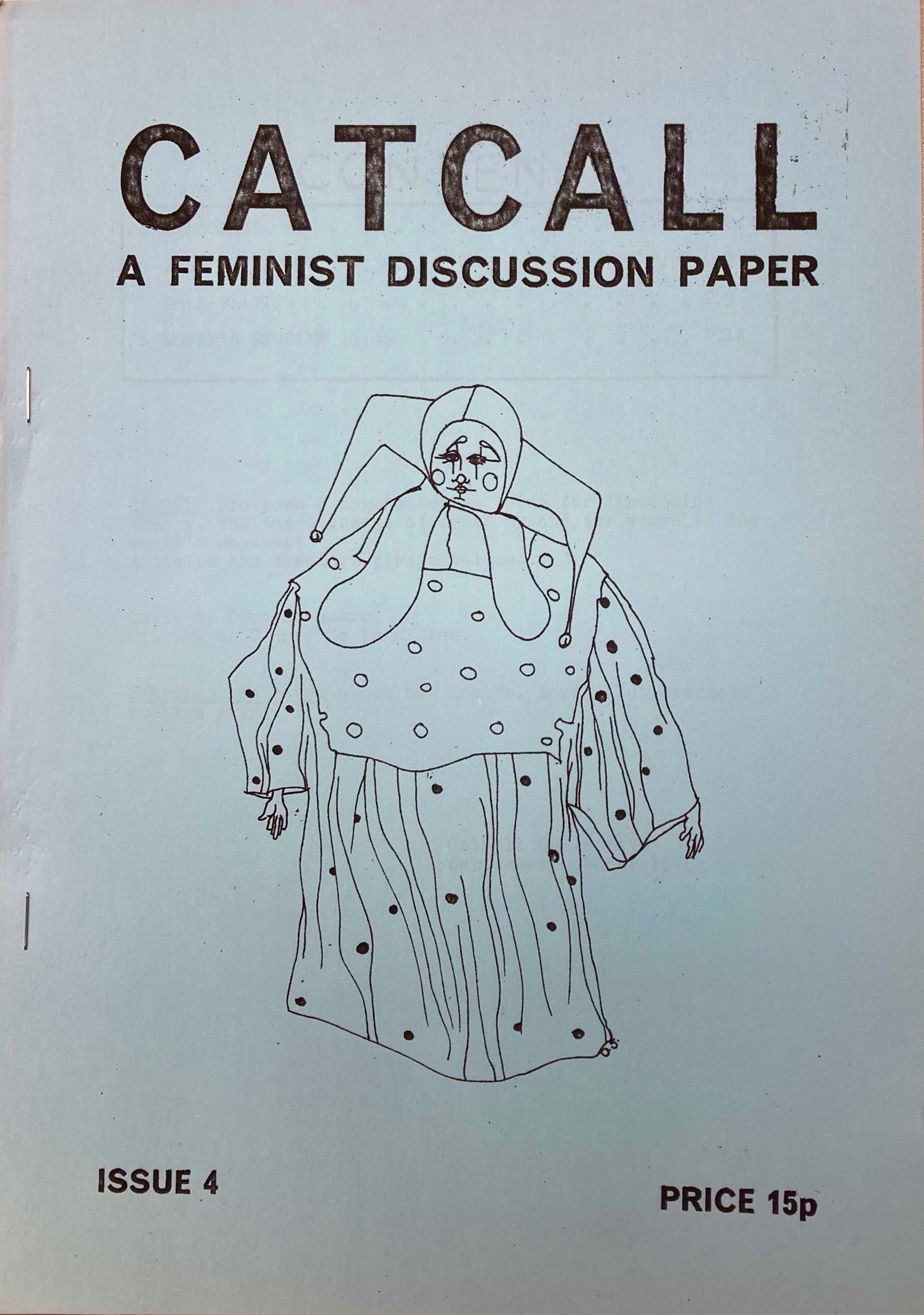
In this letter from 1980, writer and activist Ethel Mannin (1900-1984) refers to her own involvement with anarchism,  and comments on anarchists Emma Goldman, Marie Louise Berneri and Kitty Lamb. I had written asking if she would agree to be interviewed by members of the anarchist feminist history group, as part of our research into anarchist women in Britain. Sadly we never did get to meet her in person, and got only the  briefest of replies to some questions we subsequently sent her.   I’m uploading it now in the hope that (after all these years lurking in my filing cabinet) it may be of some use to other researchers.

First page of typescript letter from Ethel Mannin to Judy Greenway, November 20, 1980, with comments on Emma Goldman.
Letter from Ethel Mannin to Judy Greenway, 20 November 1980, p.1. Photo © Judy Greenway
Second page of typescript letter from Ethel Mannin to Judy Greenway
Letter from Ethel Mannin to Judy Greenway, 20 November 1980, p.1. Photo © Judy Greenway
book cover of Ethel Mannin's "Privileged Spectator" revised 1946 edition
First published in 1938, this is the cover of the revised 1946 edition of ‘Privileged Spectator’. Photo © Judy Greenway.

A Poem for Armistice Day 2025: Katherine Veitch by Wilfrid Gibson

Reminding us that the horrors of war extend far beyond the battlefield, Wilfrid Gibson’s poem ‘Katherine Veitch’ tells of a mother driven to madness by the loss of her son at the battle of Loos in 1915. Gibson, one of the first poets to write about World War 1, had previously described soldiers with shell-shock; in this post-war poem he dramatises the psychological consequences for  families of the war dead. He continued to write about war and its aftermath for many years after the Armistice.

The Battle of Loos, autumn 1915, was a major disaster for the British Army. There were massive casualties, and of the 21000 British troops killed, one in 3 were Scots; scarcely a town or village in Scotland was unaffected by loss. This is perhaps why Gibson chooses here to include a number of Scots/Border dialect words which would have been familiar to him from his formative years living in the borderlands of Northumberland.

Katherine Veitch

He fell at Loos: and when she heard
The tidings, though she did not stir,
Some light within her at the word
Was darkened; and it seemed to her
Death sought to snatch her bairn from her —
To snatch her suckling babe from her:

And she forgot that he had grown
A hefty lad, to be her pride,
A shepherd for skilled piping known
Throughout the hilly Borderside,
Until they took him from her side,
No more to seek his minney’s side.

By day or night, she cannot rest —
Stravaging over Auchopecairn
She clutches to her naked breast
An old clout-dolly, like a bairn,
And moans — My bairn, my hinney bairn!
Death shall not have my wee bit bairn!

Germinal No 1, [July 1923]; reprinted in Wilfrid Gibson, 1925,
I Heard a Sailor and other poems
.

Notes

Auchopecairn  [ or Auchope Cairn] is in the Cheviots, near the Scottish/English border. This bleak, rocky, and windswept spot is likely to be a place Gibson knew first-hand, as  a keen walker of his native moors and hills.

Clout-dolly: rag doll.

Minney: term of endearment for mother

Hinney bairn: darling child

Stravaging: wandering aimlessly

More Gibson poems relating to war.

For Armistice Day 2023: poem by Wilfrid Gibson

Wilfrid Gibson poems for Armistice Day, November 2018

War is a business of innumerable personal tragedies: Wilfrid Gibson, Elizabeth Gibson Cheyne and the First World War

Copyright:  All Wilfrid Gibson poems © trustees of the Wilfrid Gibson estate.

COMING SOON
In 1923 Katherine Veitch was included in the launch issue of Germinal, a short-lived literary magazine edited by socialist feminist Sylvia Pankhurst. More on the connection between Wilfrid Gibson and Sylvia Pankhurst coming soon to this site.


New in February 2025: ‘I am a Suffragist, Socialist and Freethinker’: Shaping a Political Identity in the Early 20th Century

When British poet and aphorist Elizabeth Gibson Cheyne described herself in Who’s Who as a suffragist, socialist and freethinker, she was actively constructing a public identity not just as a writer, but as an activist. But identities can’t be so neatly categorised and controlled. I have just uploaded a short paper discussing some of the shifts and contradictions in Gibson Cheyne’s self-created identity/ies, and how these can be interpreted.The paper also touches briefly on the often uncomfortable processes of negotiating and re-presenting my own identity: as a person working between disciplines, both inside and outside academia, while researching and shaping my version of someone who was a forgotten member of my own family.

More about Elizabeth Gibson Cheyne here.


For Armistice Day 2023: poem by Wilfrid Gibson

This lesser-known war poem by Wilfrid Gibson was written shortly after the birth of his first child, Audrey, on May 31, 1916. It remains all too relevant today

One-Day-Old

Baby asleep on my arm,
Would that my heart could enfold you,
Cherish you, shelter you, hold you
Ever from harm.

Born in a season of strife
When warring with fire and thunder
Men wantonly shatter asunder
All that was life—

Into a world full of death
You come with a gift for the living
Of quiet grey eyes and giving
Of innocent breath.

Baby asleep on my arm,
Would that my heart could enfold you,
Cherish you, shelter you, hold you
Ever from harm!

In 1937, Audrey Gibson married  Albrecht (Ali) Hübsch, a German citizen then working in England. Soon after the birth of their son Roland the following year, with war once again looming on the horizon, they left England to avoid Ali being interned as an enemy alien. In August 1939,  Audrey was killed in an accident,  and since Ali was waiting to be called up for the German army, Roland was brought back to England by his grandparents. As another World War began, Wilfrid and his wife Geraldine once again found themselves caring for a baby amid the horrors and fears of wartime.

More war poems and further information
Poems posted for Armistice Day
A Poem for Armistice Day 2025: Katherine Veitch by Wilfrid Gibson
Suspense
Wilfrid Gibson: biographical information and timeline.
‘War is a business of innumerable personal tragedies’: Wilfrid Gibson, Elizabeth Gibson Cheyne, and the First World War.
Writings on war by Elizabeth Gibson Cheyne (Wilfrid’s sister).
More on Wilfrid Gibson as a father.
More on the Gibsons.

Copyright:  All poems © trustees of the Wilfrid Gibson estate.


New in November 2023: ‘A Poet among the Social Reformers’, Elizabeth Gibson Cheyne: Suffragist, Socialist and Freethinker.

True patriotism is a burning shame for our country’s injustice and wrongdoing’
— Elizabeth Gibson, 1908.
British poet Elizabeth Gibson Cheyne contributed to the ferment of new ideas about art, religion, poetry and politics in the early twentieth century. She was a suffragist, socialist and freethinker as well as a poet, and her social networks included artists, feminists, reformers and revolutionaries. I’ve just uploaded the text of a talk I gave at a Socialist History Group  seminar at the Institute for Historical Research, London, on 20 February, 2023. I’ve added notes and references, plus a new Afternote speculating about possible connections between individuals and groups in Britain and Chicago.

‘A Poet among the Social Reformers’ Elizabeth Gibson Cheyne: Suffragist, Socialist and Freethinker


New in August 2023: 1970s Women’s Liberation Movement articles from Catcall.

‘Strength will not come through hiding or minimizing our differences.’ Two articles originally published in the nineteen-seventies give an insight into some of the developments and political debates in the UK Women’s Liberation Movement at the time, while raising some issues still relevant to feminist and other social movements today.

Censorship and Self-oppression (1976) by Judy Greenway, argues that difficulties in dealing with disagreements and controversy can lead to suppression of dissent and a ‘tyranny of virtue’ within some parts of the Women’s Liberation Movement, and urges the necessity of open discussion.

Anarchism and The Women’s Liberation Movement (1977) by Lynn Alderson, argues for the relevance of anarchist ideas to autonomous feminist organising. Originally written as a starting point for discussion at a conference on Feminism and Anarchism, it now includes her new afterword, contextualising and reflecting on those earlier debates.

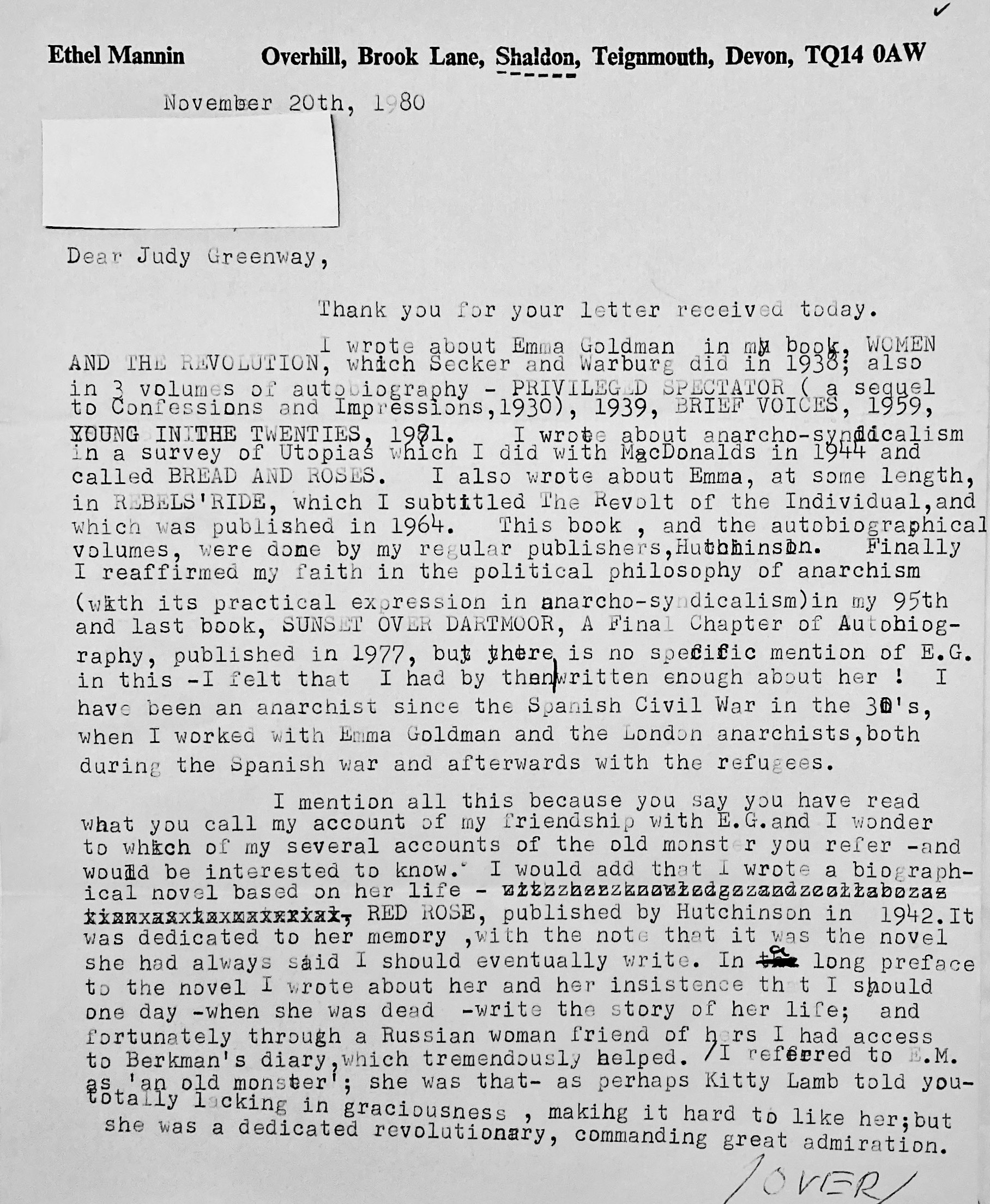
Cover of Catcall: a feminist discussion paper, issue 4, price 15p, with drawing of woman in a clown or carnival costume

Both articles were published in Catcall, a feminist paper which aimed to provide a space where such debates could take place, providing a non-sectarian open forum ‘for discussion, theory, and the exchange of ideas by and for women in the women’s liberation movement’, with an emphasis on the relationship between theory and practice. Originally founded by Margot Farnham, Deborah Hart and myself, it was produced collectively and sold at cost price in women’s centres, at meetings, conferences and demonstrations, or by subscription. There were sixteen issues altogether, published at irregular intervals between 1976 and 1984. I hope to write more about Catcall at a later date.


News July 2023: Elizabeth Gibson Cheyne Added to the Oxford Dictionary of National Biography; plus new selection of her poems

I’m happy to announce that my biographical article about Elizabeth Gibson Cheyne has just been published in the Oxford Dictionary of National Biography online.  In her lifetime she was sufficiently well known to be included in Who’s Who (first appearing there in 1912, a year earlier than her brother, poet  Wilfrid Gibson)—but it has taken almost a century for her to join  Wilfrid and her husband Thomas Kelly Cheyne in the ODNB. The article is available behind a paywall, but can be read for free in public and academic libraries in the UK. The basic outline of her life remains available on this website.

To mark the occasion, I’m publishing a selection of poems from  her 1910 collection From the Wilderness. This  self-published book of free verse, with its plainer language,and more overtly political  themes, marks a shift in form and content from most of her previous poetry. I’ve chosen poems that illuminate her engagement with the feminist, socialist, and freethought debates of the period.  They also tie in with an online talk I gave earlier this year, ‘A Poet among the Social Reformers’: Elizabeth Gibson,  Socialist, Suffragist and Freethinker’,  which I’m currently writing up prior to uploading it here. Watch this space! [Now available with this link.]

Also coming soon: a couple of articles from the  1970’s feminist paper Catcall, one on Anarchist Feminism and one on Censorship and Self-oppression.


New in October 2022: ‘I didn’t know I was the child of unusual parents’: Tom Keell Wolfe interview notes

In June 1916, London anarchists Lilian Wolfe and her companion, Tom Keell, were prosecuted under the wartime Defence of the Realm Act for publishing an anti-conscription leaflet. Lilian, who was pregnant at the time, pleaded ‘Guilty – of telling the truth’. Both chose prison rather than paying fines, though Lilian was released early because of ill health. When the time came for her to give birth, the hospital refused to admit her – not because she was an unmarried mother, but because she was an ‘unrepentant sinner’ who lived with the father of her child.

I have just uploaded the notes from a 1981 interview with that child – Tom Keell Wolfe. As well as material about his parents, the interview includes Tom’s memories of life in the anarchist colony Whiteway, encounters with Emma Goldman, Sylvia Pankhurst, George Orwell and others, and his own involvement with the Peace Pledge Union. He also talks about Annie Adama van Scheltema and her key role in setting up the International Institute for Social History in Amsterdam.

More about Lilian Wolfe.

This post is the second in my project to make available some raw research material from my own archives. In future I hope to upload notes from interviews with Fermin Rocker, (another child of anarchist parents), and Tessa Marin and others talking about their experiences living in Whiteway.


New in August 2022: ‘I was born an anarchist’: Kitty Lamb interview notes

I have just posted unpublished notes from two interviews with activist Kitty Lamb (1901 – 1992) about her life and the development of her anarchist beliefs. She participated in raising money for the Republic during the Spanish Civil War, war resistance in the Second World War, the campaign against capital punishment in the nineteen-fifties, and for nuclear disarmament in the sixties. She took the platform at Speakers Corner, and the stage in anarchist cabaret. Self-deprecating though she was about her own activities, these fragmentary stories illustrate her lifelong commitment to a better world, and give an insight into the shifting social and political groupings and alliances of the times.

The interviews were carried out at the beginning of the nineteen eighties, as part of the activities of the Anarchist Feminist History Group. The notes were never written up, and though the sessions were recorded, the current whereabouts of the tapes is unknown. What survives are the notes and a contemporaneous typescript of part of those notes. Rather than leave these gathering yet more dust among my papers, I have decided to make them available online for other researchers to use.

Time permitting, I hope to  add more such unpublished research material on my website in future.

Wilfrid Gibson poems for Armistice Day, November 2018

Here are four poems for Armistice Day, by Wilfrid Gibson. Best known  for his  poems of the First World War, he continued to write about war and its aftermath until the Second World War. For more of his war poems, see Suspense and War Poems

Bacchanal (November, 1918)

 Into the twilight of Trafalgar Square
They pour from every quarter, banging drums
And tootling penny trumpets – to a blare
Of tin mouth organs, while a sailor strums
A solitary banjo, lads and girls
Locked in embraces in a wild dishevel
Of flags and streaming hair, with curdling skirls
Surge in a frenzied reeling panic revel.

Lads who so long have stared death in the face,
Girls who so long have tended death’s machines,
Released from the numb terror shriek and prance –
And, watching them, I see the outrageous dance,
The frantic torches and the tambourines
Tumultuous on the midnight hills of Thrace.

From ‘Neighbours’, 1920.

“The Glorious Dead”

He talked about “the glorious dead”,
And how we always should remember them;
And then she turned on him and said –
If you mean Willie, Dick and Jem,
The living lads they took from me

To blow to pieces with artillery –
Much good to them ’twill do
To be remembered by the likes of you;
And as for “glorious memory,”
What’s that, think you, to me
When out of sleep I start up in my bed
Remembering my little lads are dead?

From ‘Aftermath’, 1930

The Kill

He saw a figure crouching in the crags,
And fired; then charged with bayonet fixed to find,
That writhing body, slumped behind
A boulder on the rocky shelf,
Was his own self.

From ‘The Outpost’, 1944.


poem "Armistice Day, 1932" by Wilfrid Gibson on red background with white peace poppies.

Image by Judy Greenway
All poems © trustees of the Wilfrid Gibson estate.