
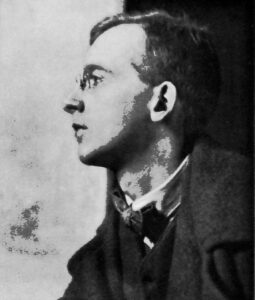
Between 1914 and 1921, work by poet Wilfrid Gibson appeared in Sylvia Pankhurst’s socialist feminist paper The Woman’s Dreadnought. The association throws light on the interwoven social, political and cultural networks of the time, and on Gibson’s commitment to ‘Art for Life’s Sake’: poetry as a form of activism. It demonstrates the connections between speakers and listeners, writers and readers, poetry and reportage, and between the stories told — all helping to create an imaginative space in and from which radical politics could flourish.
This article was first published in Dymock Poets and Friends, Number 26, 2026. pp.15-27. ISSN2399-9780. The version here incorporates some slight alterations and corrections.
Download as Word docx
Download as PDF
This work is licensed under a Creative Commons Attribution-NonCommercial 4.0 International License.

Key Words: East London Federation of Suffragettes, Woman’s Dreadnought, Women’s Social and Political Union, Workers’ Dreadnought, socialism, feminism, history, poetry
People: Wilfrid Gibson, Sylvia Pankhurst, Elizabeth Gibson, Geraldine Gibson, Jane Hay, Marjorie Kennedy-Fraser
Dreadnoughts: Wilfrid Gibson, Sylvia Pankhurst and The Woman’s Dreadnought
Between 1914 and 1921, work by the poet Wilfrid Gibson made a number of appearances in the weekly socialist feminist paper the Woman’s Dreadnought. Though Gibson rejected political labels for himself, he was heralded in his lifetime as ‘The People’s Poet’ or the “Poet of the Poor’: his poems and dramas spoke of the everyday lives of working men and women, rural and urban labourers, and the double oppression of working class women as wives and mothers. It is not surprising, then, that suffragette and socialist Sylvia Pankhurst, the Dreadnought’s editor, chose to publish some of them; poetry regularly featured in its pages, as it did in many other radical publications, and Gibson’s themes and subject matter were a good fit. The association provides a rare glimpse into how Gibson himself saw the relationship between poetry and politics.
Pankhurst, together with her mother and sister, Emmeline and Christabel Pankhurst, was a leading figure in the Women’s Social and Political Union (WSPU), the best known of the early twentieth century militant suffrage groups. While in the USA lecturing on the British suffragette movement, she spent time in Chicago, where she met striking garment workers and other women who combined feminist and labour activism. Enthused by their example, on her return to Britain she began to organize with working class women in Bow, the heart of London’s East End, and in early 1914 broke away from the WSPU and co-founded the East London Federation of Suffragettes (ELFS), and its newspaper the Woman’s Dreadnought.
Gibson’s poem ‘The Dreadnought’, though first published a year before the paper was founded, could have been specially written for it:
The Dreadnought
Breasting the tide of the traffic the ‘Dreadnought’ comes,
Beribboned and gay, the first of the holiday brakes
Brimful of broken old women, a parish’s mothers,
Bearing them out for the day, from grey alleys and slums —
A day in the Forest of Epping grown green for their sakes.
Listless and stolid they crouch, everlastingly tired,
Mere bundles of patience outworn, half-deaf and half-blind,
Save only one apple-cheeked grannie more brisk than the others,
Who, remembering with youth in her heart and the old dreams desired,
Sits kissing her hand to the drivers who follow behind.[1]
‘Dreadnought’, for centuries a common name for ships, took on fresh connotations in the early twentieth century when, as part of the escalating arms race between Britain and Germany, the Royal Navy launched its advanced model of battleship, the H.MS. Dreadnought. Soon, all such ships were being referred to as dreadnoughts, and the jingoistic slogan, ‘We want 8 and we won’t wait’ echoed across the country as the two nations vied for military-industrial supremacy and readied for war. In this context, the word became part of popular culture, evoking British imperial power. By contrast, the Dreadnought of Gibson’s poem is a humble, sociable vehicle, used by women for peaceful purposes, for pleasure not power — the antithesis of militarism.
A rather different take on power is connoted by the democratically chosen title of the Woman’s Dreadnought. As an editorial note explained:
The name […] is symbolic of the fact that the women who are fighting for freedom must fear nothing. It suggests also the policy of social care and reconstruction, which is the policy of awakening womanhood throughout the world, as opposed to the cruel, disorganized struggle for existence among individuals and nations from which Humanity has suffered in the past. [… T]he chief duty of The Dreadnought will be to deal with the franchise question from the working woman’s point of view, and to report the activities of the votes for women movement in East London. Nevertheless, the paper will not fail to review the whole field of the women’s emancipation movement.[2]
Here, the name both draws on and subverts the notion of fighting spirit, while repurposing and reframing it in a feminist context.
Boudicca, the Ancient Briton warrior queen, was another icon of British nationalism and military power then undergoing a feminist re-working as a symbol of courage and resistance for the suffragettes. Days before war was declared, a livelier outing of women than that in Gibson’s poem set off from the East End to Epping Forest, headed for a picnic at the historic site of Boudicca’s Camp in Theydon Bois.
Many brakes of holiday makers stopped at the Wake Arms, L[ou]ghton, on their way to Epping. Booths of sweets and fruit were erected by the road side in the hope that the fortunate travellers would buy; little barefoot boys turned somersaults for coppers, and men and women with big baskets flocked around, selling flowers.
Three of the brakes were decorated with bright purple, white and green and red flags and posters advertising the Woman’s Dreadnought. Everyone knew that they belonged to the East London suffragettes.
One of the flower sellers waited for a quiet moment to tell the suffragettes her story:
She said that she was Mrs. Mercer and that she lived at 2 Albert Road, North Buckhurst Hill. Her husband was out of work and she was the breadwinner for him and herself and three small children. One day she had been very ill and in the evening went out to find her husband. She met him in the road, and was having ‘a few words with him’ because he had left her alone in the house all day, when a policeman came up and told her to be off. She refused and the policeman began to push her. She said ‘Leave me alone, my husband is the only one who has the right to handle me.’
Arrested and charged with disorderly conduct, unable to afford the fare to get to court because it would leave her children hungry, she was then fined for non-appearance. Despite not being convicted of an offence, her inability to pay this fine landed her with a month in Holloway prison; her children were sent to the workhouse.[3]
This tale of injustice appeared — alongside news of current suffrage campaigns and a piece calling for rent strikes against poor housing conditions — on the front page of the Dreadnought‘s next issue. Such personal stories featured regularly, the inclusion of names and addresses giving an assurance of veracity. Pankhurst wanted the paper ‘to be a medium through which working women […]might express themselves, and find their interests defended.’ She aimed for articles ‘to be as far as possible written from life; no dry arguments, but a vivid presentment of things as they are, arguing always from the particular, with all its human features, to the general principle’, and trying always to preserve the spirit and freshness of working women’s own voices.[4]
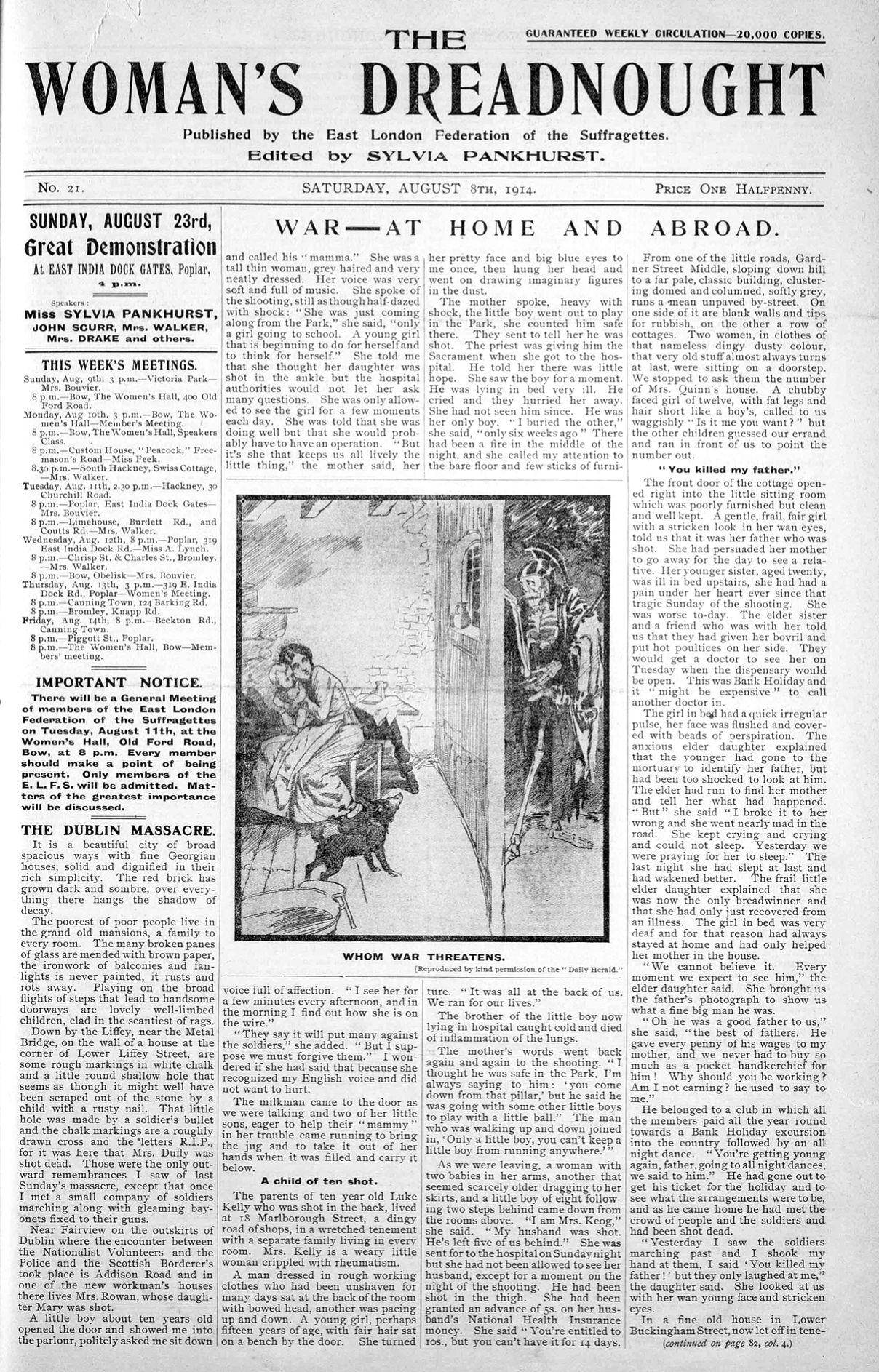
The next issue, on the 8th of August 1914, carried the front-page headline ‘War — at Home and Abroad’. Drawing on witness accounts and interviews, lead articles covered an army massacre of unarmed civilians in Dublin, the departure of reservists to war, and the impact of dramatic rises in food prices. On an inside page, alongside reports of local and national suffragette activity, Wilfrid Gibson made his first appearance in the paper with a short poetic drama from Daily Bread (1910), the book which made his name.
‘Summer Dawn’ is set in a farm workers’ cottage before sunrise:
Laban still lies in bed, dozing; but his wife Betty is already dressed, and is setting the kettle on a newly-lit fire. In the bed, beside Laban, is a six-months-old baby; and in another bed are five children, all under the age of seven; the boys sleeping at one end, the girls, at the other.
Betty: Come lad, get up, or we’ll be late. […]
It’s getting on for three.
The fire is kindling famously.
I’ll have the kettle boiling in a twinkling.
We’ll have a cup of tea, before we start,
To keep the bitter chill out.
It’s raw work, turning out these dewy mornings.
Laban: It seems but half-an-hour ago,
Since I lay down in bed.
Betty: Nay, Laban, it was half-past ten,
At most, when you turned in.
You’d scarcely got your trousers off,
Before you dropt asleep:
And you were snoring like a pig […]
‘Twas nigh eleven when I got to bed.
Laban: I can’t tell how you manage.
A man must have his sleep out,
If he’s to do his day’s work,
But women, somehow, seem …[5]
At this point Betty brusquely interrupts, telling him to get a move on. As they ready themselves for the day ahead, they talk about the hardships of low paid work, the unpaid drudgery of housework, and the difficulties of raising a family in such conditions. The piece ends as dawn breaks and both parents leave for work: the sleeping children, presumably, will have to fend for themselves.
Another short play from Daily Bread appeared a fortnight later. ‘Mates’ depicts the conflict between a miner, Martin, who has narrowly escaped the pit disaster in which his father and brothers died; his now ‘mateless’ mother Charlotte, who urges him to take up safer work; and his fiancée Grace, who, having lost her own father and brothers in the disaster, does not want to become yet another anxious wife or grieving widow. While the women speak movingly of the dangers of pit work, as well as the fear and suffering of miners’ wives, Martin speaks of his feelings for his mates down the pit, and one in particular who risked his life to save him: to leave his friends would be cowardly, unmanly. Grace tells him ‘I cannot lead your mother’s life’, and gives an ultimatum: he must choose between her or his mates. But the play finishes as Martin says he chooses both — and Grace gives in. While this ending could be taken as a kind of fatalistic acquiescence to the status quo, it is also an affirmation of love, and the piece as a whole gives voice to those caught up in the interconnections, cross-tensions and contradictions between class and gender, love and comradeship, male and female solidarity.
The outbreak of war brought about major rifts within and between the different women’s suffrage groups, and while the leadership of the WSPU suspended suffrage activism and supported the war effort in their new paper Britannia, the ELFS concentrated on relief work in the East End and the Dreadnought continued to campaign for both votes and international peace, arguing that the two issues were interconnected.
Gibson, meanwhile, greeted the war with horror, and early in 1916, the paper published Pankhurst’s admiring review of Battle, his groundbreaking collection of antiheroic war poems. Including some in their entirety, quoting extensively from others, she praised Gibson as ‘a poet of workaday life’, commending the ‘intimate realism’ of his writing.
[O]ne feels, whether it be so or not, that he has actually experienced the life of the trenches, and that he has recreated their very atmosphere for us, and is telling us the things that are really said and done there every day.’[6]
A few weeks later, the paper carried another poem from the collection. ‘Comrades’ gives us the voices of two soldiers from the muddy ‘field of blood’ in Flanders: one from the current war, the other, long forgotten, who fell at Waterloo a hundred years earlier. No glory here, only endurance.[7]
Summer that year saw a different, more direct, connection between Gibson and the Dreadnought, with the announcement that the ‘distinguished author’ had agreed to judge an essay competition on the question, ‘Who Suffers Most by the War?’ The probable instigator of the competition was Muriel Lester, an east London peace campaigner and social reformer, who was to provide the unspecified prize (which eventually turned out to be a book).[8] Disappointingly, neither topic nor mystery prize seem to have sparked the enthusiasm of potential contributors; despite an extension of the deadline, in the event only seven essays were submitted. The winning piece by E. L. Osmond was published, alongside Gibson’s comments. Osmond uses the example of a working-class family to argue in vivid detail that it is unquestionably the mother who suffers most by the war: it is the mother who most intensely fears for their soldier sons and their other children, and who also has to endure the domestic drudgery and day-to-day practical struggles involved in running a household in the face of ever-increasing economic hardship. When the husband’s income is reduced, leaving less money for food, ‘he argues that men who have hard manual work to do must feed well — women’s work is much less strenuous and she can always sit down if she is tired.’ So the mother goes without, to try and ensure the husband and growing children can get enough. The essay concludes:
When the husband reads triumphantly the defeat of the enemy and the list of his losses, how can the mother rejoice in the victory? She cannot help picturing the numbers of fine, strong young men who have fallen as the price of victory or defeat, all mothers’ sons like her own, whether those of friend or foe. There can be no real rejoicing for her, but an ardent longing that peace may be restored, that the time will soon come when […] war and its terrible glory perish from the face of the earth, whose beauty it is destroying.[9]
Unfortunately, having praised the winning essay and the close runner up, as might be expected, Gibson foolhardily took it upon himself to comment individually, in print, on each of the remaining entries. Though the tone of his remarks is more or less kindly, if schoolmasterish, it changes sharply when he comes to what he insultingly calls the ‘too-egotistical effusion’ of ‘A Rebel to the Last’, which, he says, ‘hardly comes within the category of essay’.
May I suggest to [‘Rebel’] as one who is ardently in sympathy with much that he has tried to express, that he would have had ample time to finish his essay if he had tried to stick to the point? I hardly dare, as one of the class of professional writers on whom he pours such scorn, to make the further suggestion that he has much to learn from those he despises; and that inexperience is not necessarily a sign of sincerity. A writer who takes the trouble to express himself with precision and lucidity is not necessarily less sincere than a carpenter who has taken the trouble to learn how to use his tools. Let me assure ‘A Rebel to the Last’ that there are some of us who mean what we say every bit as much as he means what he says; and the proof of our sincerity is that we have spared no pains to express the truth that is in us with our utmost strength and skill.
Unsurprisingly, Gibson’s words seem to have caused some ill-feeling, as evinced in the next issue:
In reply to ‘A Rebel to the Last’ the Editor wishes to point out that Mr Wilfrid Wilson Gibson, who judged the Essay Competition, is not the Editor of The Dreadnought. The Editor is not responsible for the criticisms of Mr Gibson, and Mr Gibson is not responsible for the Editor’s having extended the time allowed for the Essay Competition.[10]
As this episode suggests, and as his own family (like those of many writers) could attest, the sympathies and psychological sensitivities that appear in much of his writing were not always evident in Gibson’s personal interactions. The tone of his response to ‘Rebel’ suggests that the essay had touched a nerve. Early on in his career he had made a considered choice to produce ‘art for life’s sake’ in plain language accessible to all. Daily Bread and Battle were deliberately produced in cheap editions, in a size to fit in pocket or kitbag, and he took pride in letters from soldiers and workers telling him how much his poems meant to them. The scorn that ‘Rebel’ expressed for professional writers may have felt like a challenge not only to the genuineness of Gibson’s beliefs, but to his very presence in the paper.[11] Asserting the sincerity of his own politics, the parallel the poet draws between the hard-won craft of a writer and a carpenter echoes that in his recently published poem ‘Gold’, about writing in his attic room over the Poetry Bookshop accompanied by the noise of neighbouring goldbeaters hammering out gold leaf:
[…] And I within my garret all day long
Unto that ceaseless thudding tuned my song,
Beating out golden words in tune and time
To that dull thudding, rhyme on golden rhyme.[12]
Following his ill-judged comments, it was a long time before Gibson made another appearance in the paper. Finally deemed fit enough for the army, he enlisted as a private in 1917, and it would take years for his subsequent experiences on the home front to find their way into his poetry. Meanwhile, the East London Federation of Suffragettes became the Workers’ Suffrage Association, and the Woman’s Dreadnought renamed itself The Workers’ Dreadnought. Its changing subtitles over the years after the Russian Revolution testified to its increasingly radical politics — from workers’ suffrage to international communism to antiparliamentary communism. To what extent, if at all, Gibson was in sympathy with all of these developments is unknown. In the immediate post-war years he had hopes — soon dashed — for the better world promised by the Labour Party and the League of Nations, but by the mid-thirties he would declare himself ‘not an ‘ist of any sort’, believing that political ideologies led to dehumanisation and violence.[13] In October 1921, however, shortly after Pankhurst was released from a spell in prison for publishing seditious material, his gentle Dreadnought poem appeared in her paper alongside fiery articles on international communism.[14]
Later that year saw the first in a series of advertisements for a forthcoming literary journal, Germinal. [15] This ‘Monthly Magazine of Modernity’ was also to be edited by Pankhurst, and Wilfrid Gibson one of the promised contributors. Perhaps inspired by the ‘little magazines’ of the USA, with their combination of aesthetic and political radicalism, its first issue eventually appeared in July 1923. It featured Gibson’s poem ‘Katherine Veitch’, telling of a mother driven mad by the loss of her son at the battle of Loos: one of his many poems about the impact of war on soldiers and non-combatants alike.[16] Only one further issue of Germinal appeared, and in 1924 the Dreadnought, too, ceased publication.
***
Though there must have been some correspondence between Pankhurst and Gibson, none appears to have survived. Late in life, Gibson destroyed most of the letters he had received over the years, while the Dreadnought‘s records mostly seem to have gone missing amidst ongoing police surveillance, raids and arrests. Whether or not the two of them ever met in person, remains uncertain.
They did, however, definitely belong to overlapping social networks. Gibson, though never a joiner of groups himself, was close to a number of women who were actively involved in radical and progressive causes, including the militant suffrage movement. His wife, Geraldine attended WSPU meetings in London in the years before their marriage. His elder sister and fellow poet Elizabeth Gibson, a major influence in his life, was on the committee of the Women Writers Suffrage League, and declared herself proudly in Who’s Who to be a suffragist, socialist and freethinker. He and his sister often visited Jane Hay (to whom Daily Bread was dedicated) and her companion Isabel Cowe at their home in St. Abbs; both Hay and Cowe were committed social activists as well as members of the Women’s Freedom League, a non-violent, anti-war militant suffrage group. Their mutual friend Marjorie Kennedy-Fraser was also active in the labour and militant suffrage movements, and she and Sylvia Pankhurst participated in the same feminist peace activities and organisations during and after the Great War.[17]
These interconnecting circles also stretched across the Atlantic. At the end of 1916, Gibson travelled to the USA on a poetry-reading tour, carrying with him a letter of introduction from Kennedy-Fraser to her old friend Harriet Moody in Chicago. He already had friends and connections in the city. His former publisher Maurice Browne, with his wife Ellen van Volkenburg Browne, co-founded its influential Little Theatre, which had opened in 1912 with a production of Gibson’s feminist-inspired play Womankind. Other Chicago contacts included Harriet Monroe, who besides being editor of Poetry was an active suffragist and political progressive, and Margaret Anderson, whose modernist Little Review sought to ally the political and cultural avant-garde, combining art with feminism, anarchism, anti-militarism and anti-capitalism. Some of these people were also involved with the women’s settlement movement and labour activism which had so inspired Sylvia Pankhurst during her own earlier stay in the city; all of them were in different ways part of a complex network of interwoven progressive cultural and social movements.[18]
***
Much valuable work has been done illuminating the importance of friendship networks among poets. Gibson’s wider social networks provide a different context for his writing, while a focus on his work in the Dreadnought indicates how, for him, as for others, poetry played its part in contributing to social change.
The paper, largely supported by donations rather than sales, had no money to pay its writers, but it gave Gibson access to a working-class readership he might not otherwise have reached. (It claimed a pre-war circulation of 20,000 copies, the majority of which were given away free). Pankhurst’s desire that it should be written from life, finding and making space for stories that connected to readers’ experiences, corresponded with Gibson’s approach to his own work. He always drew his material from a variety of sources. ‘Breakfast’, for instance, was based on the words of a front-line soldier quoted in The Nation, while ‘Flannan Isle’, another of his best-known poems, relayed the tale told him by a fisherman when visiting Jane Hay and Isabel Cowe in St. Abbs. His unusually empathetic depictions of women’s experiences of poverty and domestic drudgery are more than likely to have been informed by stories heard from his activist women friends. The Dreadnought was another potential source.
There (and in Germinal) stories like those of Mrs. Mercer, the real-life flower seller, and Katherine Veitch, the imaginary bereaved mother, relayed and affirmed voices usually unheard. The stories resonate with one another: the husband in E.L. Osmond’s prizewinning essay, arguing that women can always sit down, is reminiscent of Laban in ‘Summer Dawn’, annoying his wife as he muses that women need less sleep. Such interconnections weave through a conversational milieu, of which Gibson was a part — a network formed between speakers and listeners, writers and readers, poetry and reportage, between the stories themselves, all helping to create an imaginative space in and from which radical politics could flourish.
Gibson once said that his autobiography was to be found in his poetry. His politics, too, are to be found in his poetry: that was where, and how, he challenged social injustice. As his essay contest comments make clear, while his sympathies were with the activists of the Dreadnought and its supporters, his writing was his activism, its sincerity guaranteed by his commitment to art — made for life’s sake.
[1] Brakes were (usually horsedrawn) charabancs — open coaches which waited for custom by stations and pubs or could be hired in advance for group outings. Epping Forest was a popular leisure destination for working class Londoners.
First published in Rhythm XII, January 1913 p.353. Reprinted in The Workers’ Dreadnought, 22 0ctober 1921 p.7. [The version here is from Gibson’s Collected Poems 1905—1925. Though the wording in all three versions is identical, the punctuation differs].
[2] Woman’s Dreadnought special advance number, 8 March 1914 p.1.
[3] ‘A Flower Seller’s Tale’, Woman’s Dreadnought, 1 August 1914, front page [unnumbered].
[4] Sylvia Pankhurst, [1931], 1977, The Suffragette Movement, Virago. London, p. 525-526.
[5] Woman’s Dreadnought 8 August 1914 p.84. Gibson revised this play before including it in his Collected Poems in 1929.
[6] E.S.P. (Sylvia Pankhurst), ‘The Life of the Trenches’, Woman’s Dreadnought. 8 April 1916 p.457.
[7] Woman’s Dreadnought, 27 May 1916 p.482. Gibson had visited Flanders as a young man, when he sometimes accompanied his father on trips to the battlefields of Europe and the Middle East. Forgotten soldiers who fought in forgotten wars for forgotten causes are a recurring theme in his work.
[8] Woman’s Dreadnought, 5 August 1916 p.526; 2 September 1916 p.539.
[9] Woman’s Dreadnought, 28 October 1916 p.579.
[10] Woman’s Dreadnought, 11 November 1916 p.591.
[11] ‘Rebel’ may also have been trying to put forward some kind of precursor of more recent debates around identity, authenticity, and who has the right to tell a story, but without access to his own words this can only be a surmise. Gibson took (or knew) him to be male, unlike the other competition entrants; possibly he belonged to the Rebels’ Social and Political Union, a local men’s group which gave practical support to the East London suffragettes.
[12] Poetry, 7:6, March 1916 p.279.
[13] Wilfrid Gibson, 20 October, 1935, letter to Dorothy Una Ratcliffe, in Wilfrid Wilson Gibson Archive, University of Leeds: BC MS 20c Gibson.
[14] Workers’ Dreadnought 22 0ctober 1921 p.7.
[15] Workers’ Dreadnought 31 December 1921 p. 7
[16] An annotated version of ‘Katherine Veitch’ is available here.
[17] Gibson occasionally accompanied his friend Kennedy-Fraser on her travels collecting Scottish folk songs — the activity for which she is now mainly remembered.
[18] For more on Gibson’s Chicago connections, see the endnote to my article, ‘ “A Poet among the Social Reformers”, Elizabeth Gibson Cheyne: Suffragist, Socialist and Freethinker’